
Saami Council statement on Indigenous mobility, climate resilience and territorial rights at UNPFII 2026
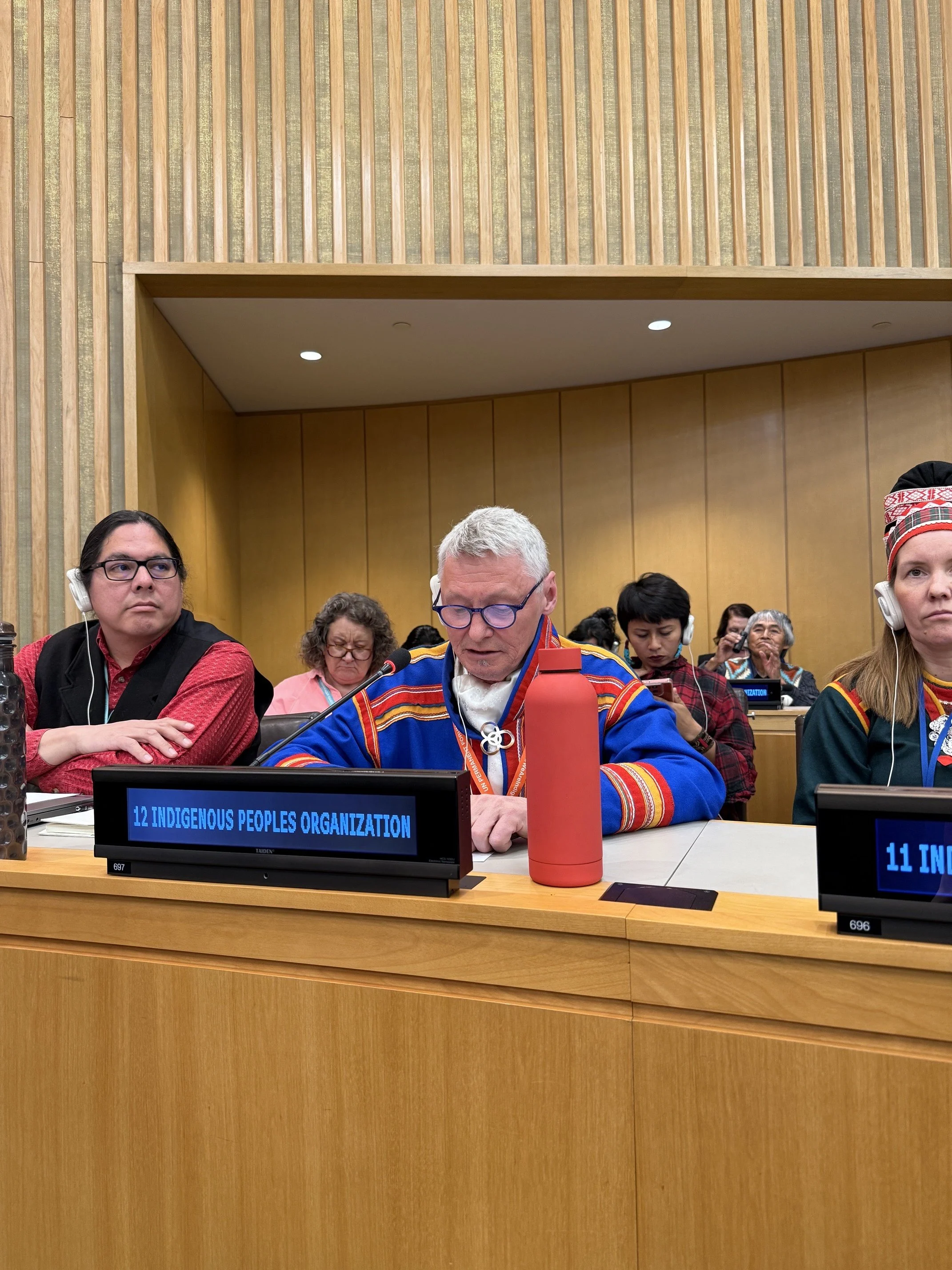
The statement was held by the President of the Saami Council, Per-Olof Nutti. Photo: Saami Council
Statement by Per Olof Nutti, President of the Saami Council, delivered on 24 April 2026 at the 25th Session of the UN Permanent Forum on Indigenous Issues under Item 4.
Item 4 International expert group meeting on the theme “Recognition of Indigenous Peoples’ rights in the context of the climate crisis, biodiversity governance and territorial integrity: focusing on nomadic and semi-nomadic peoples, including pastoralists and shifting cultivators”
Thank you, madam chair,
The Saami Council welcomes the focus of the International Expert Group Meeting on the recognition of Indigenous Peoples’ rights in the context of the climate crisis, biodiversity governance, and territorial integrity, as reflected in its report.
This theme is of particular importance for nomadic and semi-nomadic Indigenous Peoples, including the Sámi, whose cultures, livelihoods, and identities are inseparable from mobility across interconnected landscapes.
Mobility is not only central to sustainable land use, but also serves as a key adaptive strategy, enabling movement between grazing areas when weather conditions or environmental changes render certain areas inaccessible.
As a reindeer herder myself, I experience how these decisions are made in practice. Our knowledge, grounded in generations of observing and responding to changing conditions, demonstrates that Indigenous Peoples’ mobility is not only a way of life, but also a climate adaptation strategy that can inform broader climate solutions.
The Saami Council underscores that strong recognition of land rights is the foundation for climate resilience. Climate action cannot come at the expense of Indigenous Peoples’ human rights.
Mobility must be recognized as a core component of territorial rights. For the Sámi and other mobile Indigenous Peoples, seasonal migration, cross-border movement, and flexible land use are essential for sustaining livelihoods such as reindeer herding. Governance systems that assume fixed land use fail to reflect this reality and risk fragmenting territories through conservation, extraction, or infrastructure development.
A just and effective response to the climate crisis requires safeguarding Indigenous Peoples’ territorial integrity, protecting mobility, and upholding established human rights standards. Only through rights-based approaches can climate and biodiversity governance support Indigenous Peoples in sustaining their cultures, livelihoods, and enduring relationships with their lands.
The Saami Council therefore recommends that Member States and UN bodies ensure the full protection of mobility and cross-border land use for nomadic and semi-nomadic Indigenous Peoples, and recognize Indigenous knowledge systems, including mobility-based practices, as integral contributions to climate adaptation and sustainable resource management.
Giitu – Thank you.