
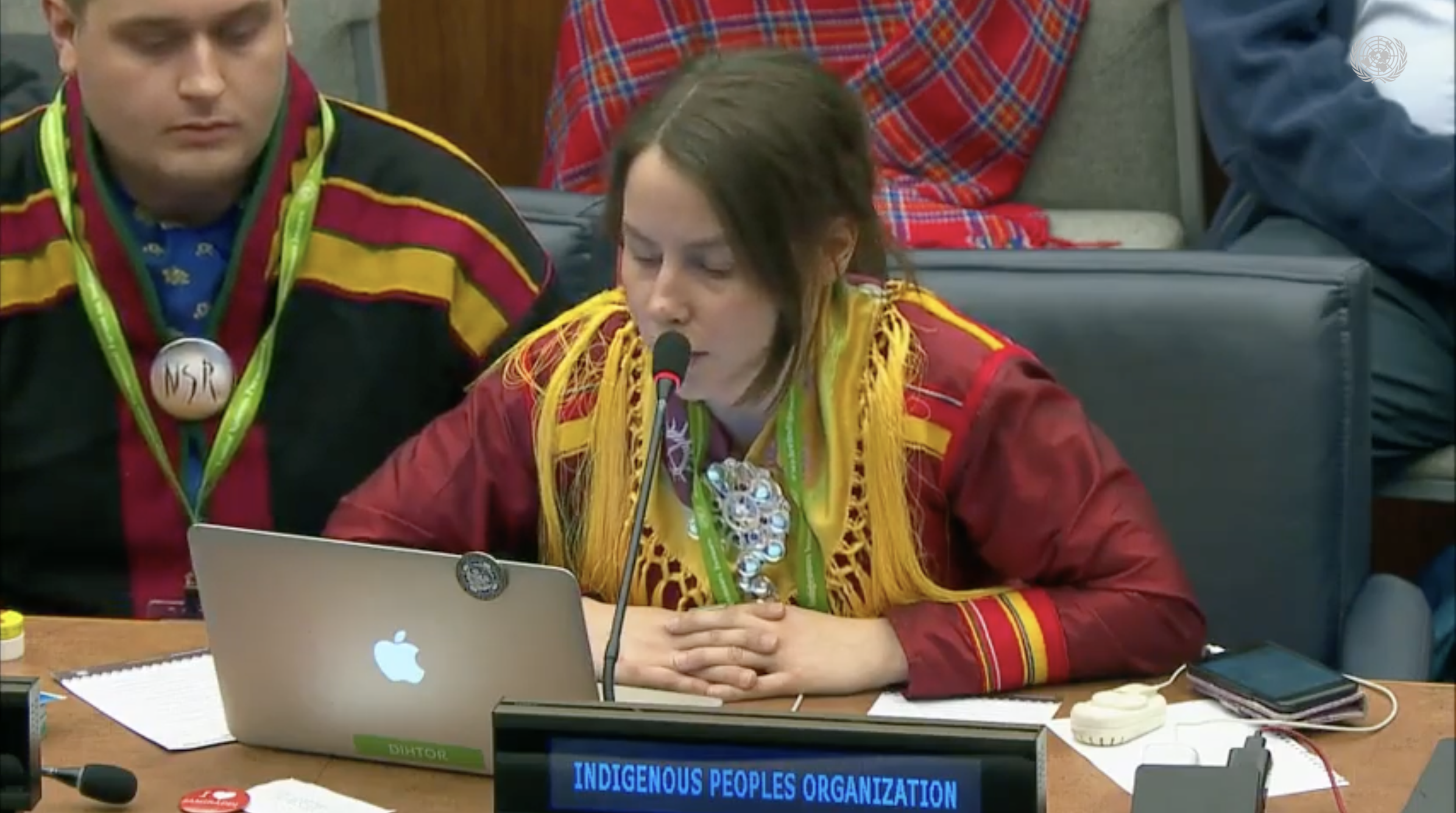
The statement was held by Lea Simma and Piera Heaika Muotka. Photo: UN Web TV
Intervention delivered by Lea Simma and Piera Heaika Muotka on behalf of the Saami Council, and endorsed by the Sami Parliaments, on 17 April 2018 at the United Nations Permanent Forum on Indigenous Issues under agenda item 8.
Item 8 “Indigenous peoples’ collective rights to lands, territories and resources”
Thank you, Madam Chair,
On behalf of the Saami Council, and endorsed by the Sami Parliaments
We welcome the topic of this agenda item, as we consider it imperative to ensure protection of Indigenous Peoples’ collective rights to lands, territories and resources in national legal framework in line with the minimum standards of UN Declaration on the rights of Indigenous Peoples. When facing encroachments on indigenous lands, territories and resources, free, prior and informed consent must be obtained on local, regional and national level.
Saami rights are protected by national and international legislation. We are concerned about the negative development in applying protection of indigenous lands, territories and resources. The lack of protection manifests in several cases the latter years where Saami rightholders are deprived of lands, territories and resources by encroachments and/or failure to identify lands, waters, coastal waters and other resources, to which the Indigenous Peoples concerned have established ownership and usufruct.
One example of good practices mentioned in the secretariat’s brief overview of the item is the Finnmark Act, which raised great expectations with regard to recognition of individual and collective rights for the Saami people to their traditional territories. We regret that the Finnmark Act, when put into effect, does not meet the high expectations. Recently, a local Saami community was tried in the Supreme Court of Norway on the right to local management of their territory. In spite of recognizing the local Saami community’s land rights, the Supreme Court ruled in favour of the Finnmark Estate, deeming the local community unqualified to implement their own usufruct.
Madam chair,
Climate change is without a doubt the biggest common threat of today. Indigenous Peoples are among those most affected by the consequences. However, we would like to emphasize that the Indigenous Peoples’ role, in activities causing climate change, has been minimal. In fact, Indigenous Peoples’ territories and lands are still the main domain for projects with negative environmental effects, such as oil and gas extraction, in spite of vocal opposition from indigenous communities.
With that in mind, it is a paradox that the most comprehensive mitigation measures are implemented in Indigenous Peoples’ territories, often in addition to already existing non-renewable resource extraction. Regardless of whether the encroachment is green or non-renewable , it will have an negative impact on the indigenous use of the lands. Climate change mitigation measures, such as wind farms, exacerbates an already unprecedented pressure on our traditional livelihoods.
The Saami Homeland is facing a dramatic surge of green colonialism. The future of reindeer herding in Åarjel Fovsen Njaarke is threatened by the fact that Europe's largest wind farm is planned to be built on their winter grazing lands at Storheia in Fosen. By contrast, the planned Gaelpie/Kalvvatnan wind farm was denied concession by the Norwegian ministry of Petroleum and Energy, with an acknowledgement of the importance of reindeer herding for South Saami language and culture and taking in consideration the cumulative effects of encroachments. The latter case, Madam Chair, is an example of best practice, but we cannot talk about best practice as long as the states aren’t consistently complying with the principle of free, prior and informed consent.
Giitu – Thank you.