
Two UN Reviews Call on Sweden to Strengthen Protections for the Sámi People
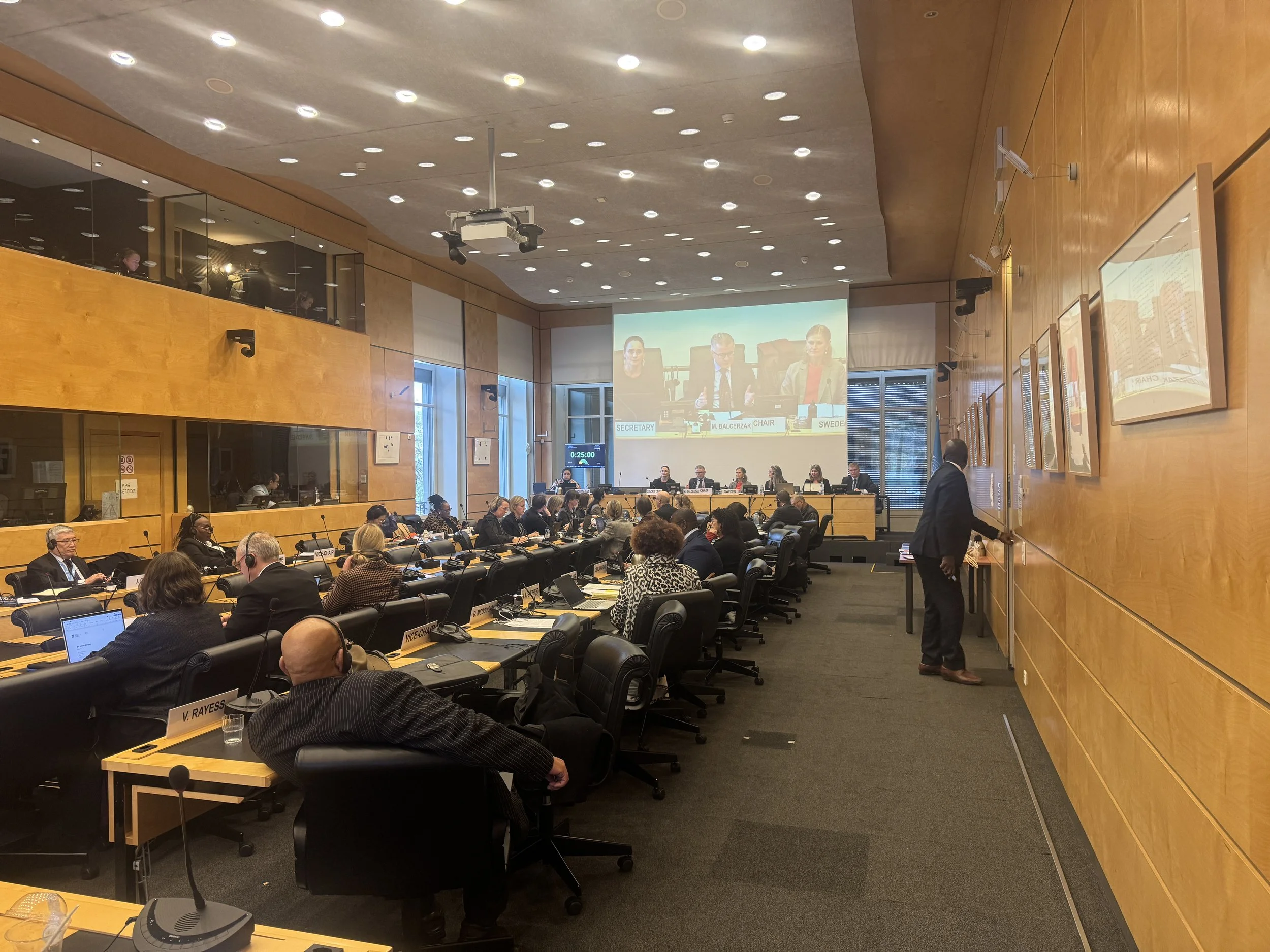
CERD review of Sweden on 20–21 November. Sweden’s delegation is seated on the panel, with CERD members in the foreground. Photo: The Saami Council
Two major UN processes in 2025 have examined Sweden’s human rights record, each delivering clear recommendations urging the state to reinforce its efforts to ensure full respect for the rights of Sámi People.

Per-Olof Nutti, The President of the Saami Council Photo: The Saami Council / Piera Heaika Muotka
Both the UN Committee on the Elimination of Racial Discrimination (CERD) and the Universal Periodic Review (UPR) highlight persistent shortcomings and call for concrete action, echoing concerns raised by the Saami Council in its submissions to both bodies. With aligned messages from the international community, expectations are high that Sweden will translate its commitments into meaningful measures.
– The message from two UN bodies is that Sweden has made commitments that must translate into real action. I have clear expectations that Sweden will take these recommendations seriously and implement concrete measures that strengthen protection for the Sámi People and fully uphold Indigenous Peoples’ Rights, says Per Olof Nutti, president of the Saami Council.
UN Committee on the Elimination of Racial Discrimination (CERD)
CERD has just recently concluding observations on Sweden, outlining a series of recommendations for how Sweden should strengthen its efforts to ensure respect for the rights of Sámi People. During CERD’s hearing of Sweden on 20 and 21 November, where the Saami Council participated and presented its own report to the Committee, the Saami Council emphasized that Sweden’s official reporting does not reflect the lived reality of Sámi communities.
CERD’s recommendations to Sweden concerning Sámi People include:
Free, Prior and Informed Consent: Review the legislative framework, including the Consultation Act, so that any measure affecting Sámi lands, territories or resources requires meaningful consultation with Sámi People and the Sámi Parliament, and obtains their free, prior and informed consent.
Impact assessments: Conduct environmental and human-rights impact assessments, with full Sámi involvement, ahead of any economic, industrial or resource-extraction projects affecting Sámi territories.
Protect Sámi land, culture and livelihoods: Adopt robust measures to prevent, mitigate and remedy harmful impacts from development, and guarantee a clean, healthy and sustainable environment.
Improve predator policy and compensation: Fully implement the 2013 predator policy and ensure adequate compensation for losses in reindeer herding.
Strengthen the Sámi Parliament: Guarantee stable, sufficient resources so it can fulfil its mandate.
Secure Sámi language education: Ensure children’s right to education in their mother tongue by investing in qualified Sámi-language teachers and sustainable language programmes.
Prevent and respond to gender-based violence: Implement effective measures to tackle domestic and gender-based violence against Sámi women, including awareness-raising and better support services.
Implement previous CERD decisions: Fully comply with the ruling in Lars-Anders Ågren et al. v. Sweden (Rönnbäcken case).
The Universal Periodic Review (UPR)
In 2025, Sweden underwent its fourth Universal Periodic Review and received more than 300 recommendations from 101 states. The concluding meeting of the Human Rights Council took place on 25 September 2025.

Eirik Larsen, Head of Human Rights Unit
Photo: Piera Heaika Muotka
Several recommendations focused directly on the rights of the Sámi People, with particular emphasis on land rights, participation, and protection from discrimination.
– The UPR review shows that the rights of the Sámi People are a recurring international concern. While Sweden has taken some positive steps, the hesitation on ratifying ILO 169 and implementing Free, Prior and Informed Consent remain major points of criticism, says Eirik Larsen, Head of the Human Rights Unit.
A strong message from the international community concerned Sweden’s failure to ratify the ILO Indigenous and Tribal Peoples Convention No. 169. Multiple states (Norway, Denmark, Germany, Mexico, Mozambique, Bolivia, Montenegro, and Paraguay) urged Sweden to move forward with the ratification of the convention. Sweden responded by noting that ratification requires approval by the Riksdag (Swedish Parliament), and that the legal consequences must first be thoroughly investigated. No timeline has been set.
Canada, Austria, and Mexico also raised concerns about Sweden’s implementation of FPIC, as set out in the UN Declaration on the Rights of Indigenous Peoples.
Several countries (New Zealand, Brazil, Finland, United Kingdom, Spain, China, Costa Rica, and Switzerland) called on Sweden to ensure the effective work of the Truth Commission for the Sámi People, stressing its importance for reconciliation and justice.
Other recommendations include:
Hate Crime Protection: Canada recommended ensuring adequate legislation and enforcement to address hate crimes, including those targeting Sámi people.
Capacity building: Canada also recommended providing Sámi organizations with the resources required to respond to increased consultation requests under the Consultation Act.
Cultural and Social Rights: Australia urged Sweden to advance Sámi economic, social, and cultural rights, including land, language, education, participation in decision-making, and the repatriation of Sámi human remains.
Action Plan: Paraguay called upon Sweden to establish a comprehensive national strategy and action plan regarding the rights of the Sámi people. Sweden noted that there are currently no plans to establish such a strategy or action plan.
Climate Change: Vanuatu recommended that Sweden ensure sufficient funding to effectively address climate change and secure a safe and healthy environment. India recommended that Sweden take steps to secure the traditional livelihoods of the Sámi community and ensure their meaningful participation in the adoption of measures under the climate change policy action plan.

Ebba Andersson, intern at the Saami Council. Photo: Private
The Saami Council will continue to monitor developments and advocate for Sweden to meet its obligations and ensure full respect for Sámi rights under international law.
– The UN reviews of Sweden confirms that the international community is watching Sweden closely. The forthcoming report from the Truth and Reconciliation Commission will be an important opportunity to follow up on the UN recommendations and take real steps toward justice and reconciliation, says Ebba Andersson, intern at the Saami Council.